How to Read a Beach: Finding Gutters, Holes and Banks Before You Cast
Why Beach Reading Beats Beach Guessing
Most blank sessions in the surf have nothing to do with bait, rigs or luck. They happen because the rod was set up over a featureless sandbank where nothing was ever going to swim. Fish move through the surf zone along predictable highways — deeper channels, holes and gutters that hold water, food and cover. Learn to spot those features and you will out-fish an angler with better gear who casts blind. At Beach Fishing Australia we treat ten minutes of walking and watching as the most productive part of any trip.
Arrive Early and Look at the Water First
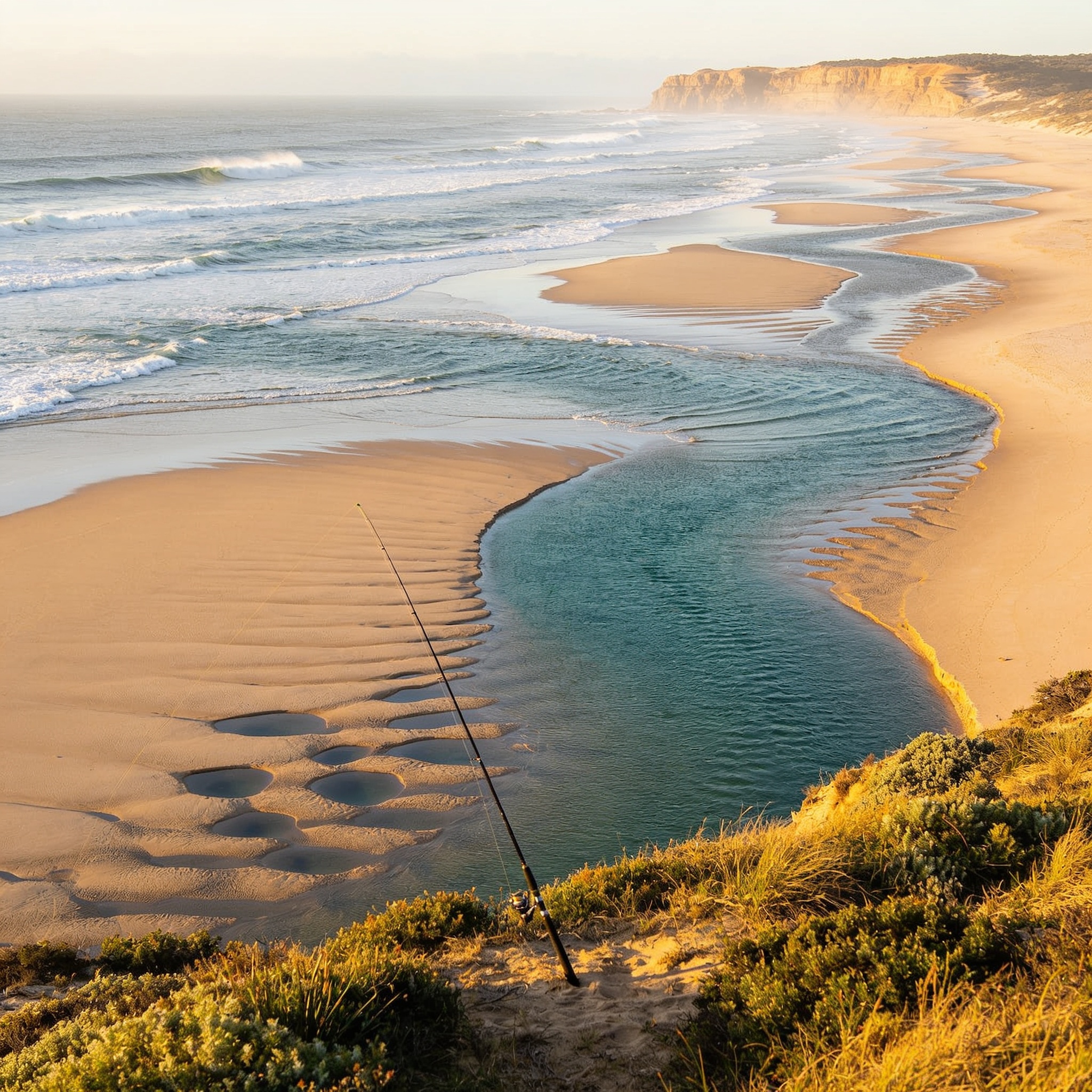
Set the rods down. Climb the dune, a headland or a set of stairs so you are looking down onto the water rather than across it. Height changes everything. From a few metres up, colour differences and wave patterns that were invisible at sand level become obvious. Low tide is the best classroom: the structure that will hold fish on the incoming tide is laid bare, and you can memorise it for later in the day.
What the Colours Tell You
- Pale green or milky sand colour — shallow water over a bank. Waves break here and fish only cross it briefly.
- Darker blue or brown-green lanes — deeper water. These are your gutters, holes and channels.
- White foam that suddenly stops — the wave has run out of bank and dropped into deeper water. The edge of that foam line is a feeding zone.
- Sandy, churned water after a swell — food is being turned over. Whiting, bream and dart will be right in it.
Gutters, Holes and Banks Explained
A bank is a raised bar of sand, often running parallel to the beach, where waves break first. A gutter is the trough between that bank and the shore — sometimes only knee-to-chest deep, but it is a continuous corridor fish patrol at close range. A hole is a deeper, rounder depression, often scooped out where two banks meet or where a rip turns. Holes hold fish for longer than gutters because they offer depth and shelter in one spot.
Short, sharp gutters close to the sand are gold for whiting, bream and dart. Long, deep gutters with clear entry points at each end suit salmon, tailor and mulloway after dark. Holes that stay wet at dead low tide are worth marking permanently in your notes.
Reading the Waves
- Watch a full set of waves, not one. Patterns repeat over two or three minutes.
- Where waves break, re-form and break again, there is a gutter between the two break lines.
- Where waves refuse to break and roll through unbroken, the water is deep — often a rip channel or hole.
- Where foam drains sideways along the beach and then swings out, you have found the feeder current into a rip.
Rips: Fish Magnets and Serious Hazards
Rips carry sand, food and baitfish seaward, and predators wait along their edges. The best presentation is usually beside the rip, not straight down the middle, where your sinker will be dragged out. Cast to the shoulder where moving water meets still water.
Treat every rip as a hazard first. Do not wade into the head of a rip to gain casting distance, never turn your back on the swell, and stay off wave-washed rock platforms in rising seas. Fish with a mate, tell someone your plan, wear a lifejacket on rocks and low ledges, and be honest about conditions — no fish on any Sydney beach is worth a rescue.
Tides, Time and Local Sydney Notes
Scout structure at low tide, then fish it on the run-in. The first two hours of an incoming tide over a freshly filling gutter is prime time, as is the last of the light and the change of tide after dark. Around Sydney, the long sandy stretches respond well to a rising tide with a moderate swell, while corner beaches tucked behind headlands are the fallback when a big southerly swell shuts everything else down.
Beaches redraw themselves after every decent swell event, so yesterday's gutter can be tomorrow's bank. Keep a simple log: date, beach, tide, swell direction, where the gutter sat and what you caught. Within a season you will have a personal map that no app can match.
A Quick Pre-Cast Checklist
- Have I looked at the beach from a high point?
- Can I see at least one gutter, hole or bank edge within casting range?
- Is my cast landing in the deeper water, or over the top of the bank?
- Which way is the sweep running, and will my sinker hold?
- Do I have a safe exit if the swell builds?
Questions about a stretch of coast near you, or want to share a beach report? Get in touch with Beach Fishing Australia on +61240309140 or [email protected] during Mon–Fri: 09:00 – 17:00 (AEST). Take your rubbish, your old line and any bycatch care with you — the gutters we read today are the ones our kids will fish.

Navigation
See also
FAQ