Long Casting Basics: Rod Length, Reel Size, Line and Shock Leaders
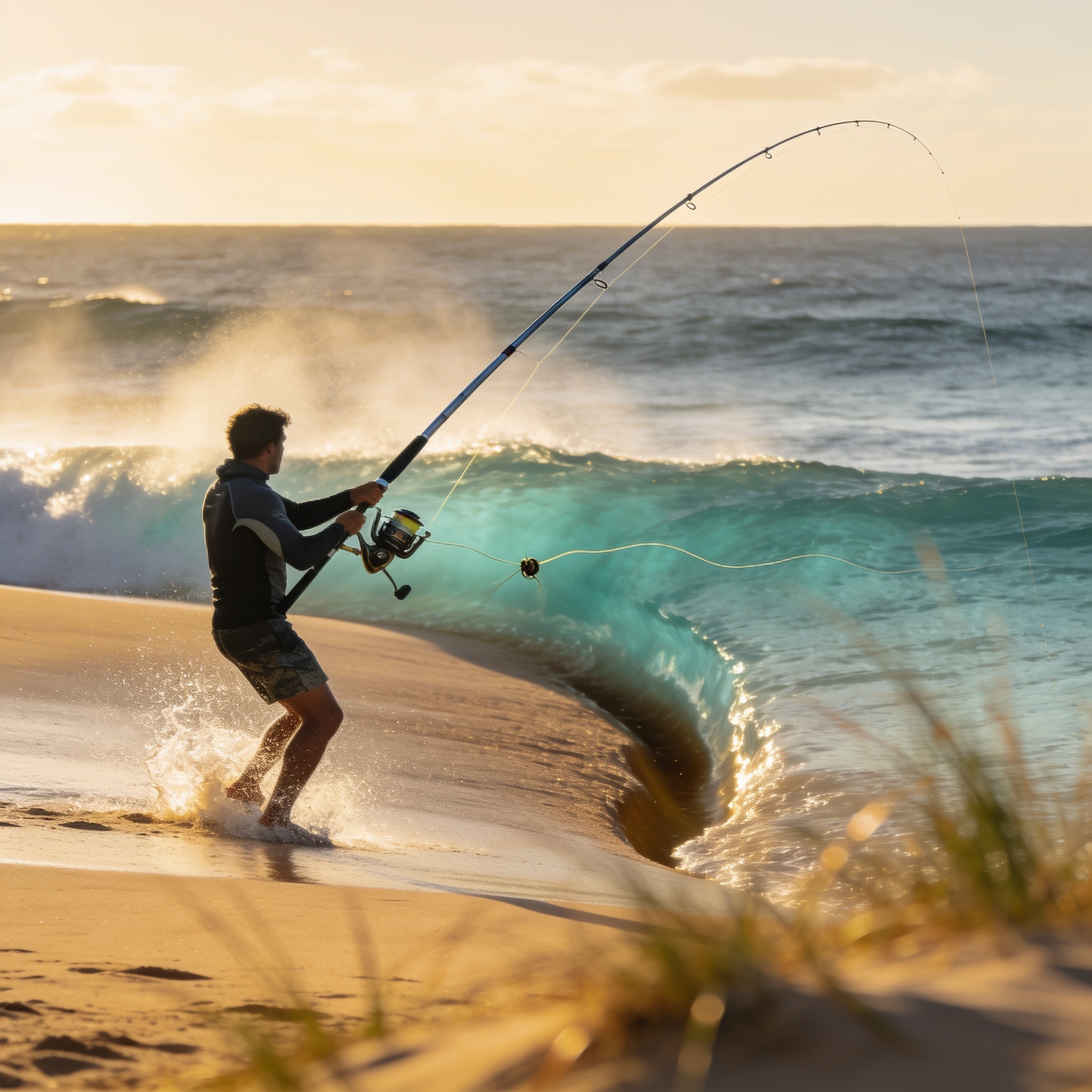
Why Distance Matters Less Than You Think
Plenty of anglers around Sydney assume that a bigger cast always means more fish. On many Sydney beaches the opposite is true: whiting, bream and dart often feed in the wash within twenty metres of your boots. Distance becomes useful when a sandbar sits well out, when a gutter runs parallel behind a bank, or when you are chasing salmon, tailor and mulloway that hold in deeper water. Learn to read the beach first, then build a setup that lets you reach the water you have identified — not the horizon.
Casting distance is the product of rod loading, smooth technique and a rig that flies straight. Gear helps, but a relaxed, well-timed swing with a modest outfit will comfortably out-cast a heavy rod swung with brute force.
Choosing Rod Length and Action
Rod length is a trade-off between leverage and control. As a rough guide:
- 9 to 10 feet: light beach and estuary-mouth work, small baits, casting 20 to 60 grams. Easy to manage in a headwind and ideal for holding a bait in the wash.
- 11 to 12 feet: the all-round Australian surf length. Enough tip height to keep line above the foam, comfortable casting weights of 60 to 120 grams, and workable with one or two hands.
- 13 to 15 feet: dedicated distance and heavy-sinker work on steep, exposed banks. Rewarding but demanding on technique and shoulders.
Action matters as much as length. A slow, progressive taper loads deeply with bait rigs and forgives timing errors. A faster tip suits lures and metal slugs where you want quick recovery. Always check the printed casting weight range and stay near the middle of it — an under-loaded rod will not compress, and an over-loaded one collapses mid-swing.
Matching Reel Size
For spinning reels, a 5000 to 6000 size covers most light beach work, while 8000 to 14000 sizes suit long rods, heavy sinkers and mulloway-class fish. Look for a wide, shallow spool with a well-shaped lip: line flows off it more freely, which is worth more real-world distance than a headline gear ratio. Fill the spool to roughly two millimetres below the lip. Underfilled spools cost distance; overfilled ones throw loops.
Overhead and side-cast reels still have a loyal following on Australian beaches. They can be superb distance tools with a smooth thumb or a well-tuned brake, but they demand practice. If you are new to the surf, start with a spinning reel and add a conventional later.
Main Line Choices
Monofilament in 6 to 10 kilogram class remains a sensible default for bait fishing. It stretches, absorbs the shock of a big fish in the shorebreak, and shrugs off sand abrasion. Braid in 10 to 20 pound offers far less diameter for the same strength, so it cuts through wind and current, transmits bites clearly and can add noticeable distance. The trade-off is zero stretch, so pulled hooks and cracked-off casts are more likely without a proper leader.
Whatever you choose, replace worn top sections regularly. A cast that lets go at full compression sends a heavy sinker downrange with real force, which is both dangerous and expensive.
Shock Leaders: The Non-Negotiable
A shock leader is a heavier length of line between your main line and rig that absorbs the enormous load at the start of the cast. The traditional rule of thumb is around ten pounds of leader strength for every ounce of sinker weight, then wind on enough leader to give five or six turns on the spool with the rig hanging near the reel.
- Length: rod length plus a few metres, so the knot sits on the spool at the start of the swing.
- Knot: a slim, low-profile join such as a slim beauty or an FG knot for braid, or a double uni for mono-to-mono. It must pass through the guides cleanly.
- Check it: inspect the leader and knot after every few casts and after every fish landed through the wash.
Putting It Together and Practising Safely
Practise on an open beach or a mown park with a sinker of the same weight you fish, never a hook. Keep a wide clear zone behind and beside you, watch for walkers and dogs, and never cast when someone is downrange. Focus on a slow start, a long smooth pull and a late release rather than a violent heave. Film a few casts if you can — most distance problems are timing, not gear.
Have a question about matching a rod to your local Sydney gutter? Get in touch with Beach Fishing Australia at [email protected] or +61240309140 during Mon–Fri: 09:00 – 17:00 (AEST) and we will point you toward a sensible, hard-wearing setup.

Navigation
See also
FAQ