Size and Bag Limits Explained and How to Check the Current Numbers
Why Limits Exist in the First Place
Every fish you pull out of the wash has a role in a bigger system. Size and bag limits are the simplest tools fisheries managers have to keep that system working: they let young fish breed at least once before they can be taken, and they cap how much any one person can remove in a day. For beach and rock fishers, that matters more than most people realise, because surf gutters concentrate schooling fish and it is genuinely easy to catch far more whiting, bream or tailor than you could ever eat.
Getting the numbers right is not just about avoiding a fine. It is about the beach you fish still holding fish in five years. At Beach Fishing Australia we treat the rule book as part of the tackle kit, right alongside your rig wallet and your sinker box.
The Four Terms You Need to Understand
- Minimum legal length — the shortest a fish may be to keep it. Measure from the tip of the snout to the tip of the tail unless your state specifies otherwise, and measure on a flat surface, not on a bowed beach spike.
- Maximum size or slot limit — some species protect the big breeders as well as the small ones, so a fish can be too large to keep.
- Bag limit (daily limit) — the number of a species one person may take in a day.
- Possession limit — the total you may have in your control, including fish in the esky at camp or in the freezer at home after multiple days. This one trips up people on long weekends away.
Some jurisdictions also apply a combined limit across a group of species, such as several types of shark or a mixed bag of reef fish. In that case you cannot simply add each species' individual limit together.
Measuring Fish Properly on the Sand
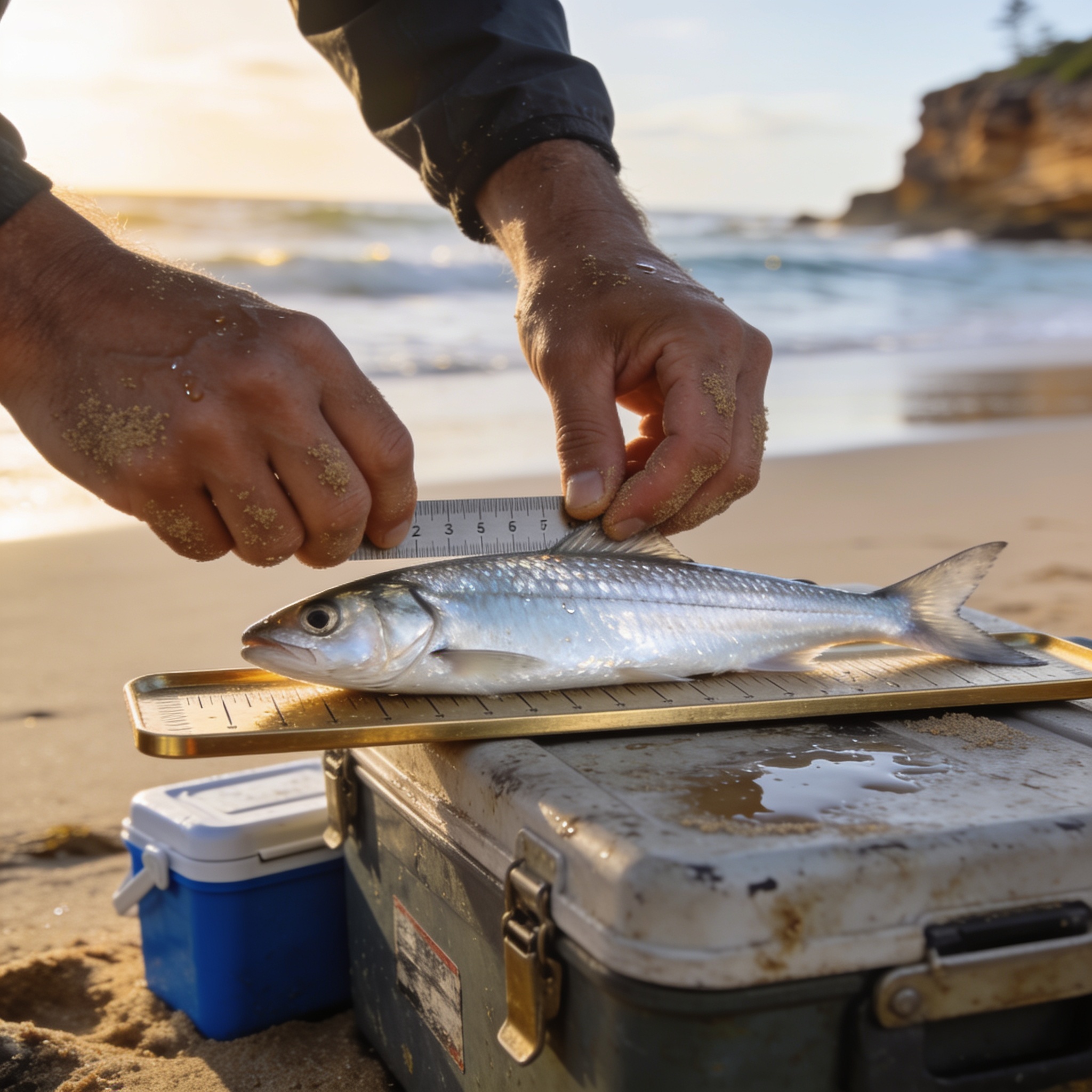
Carry a rigid brag mat or a stick-on ruler and use it every time. Estimating by hand span is how honest anglers end up with undersize fish. A few habits that help:
- Wet the mat first so the fish does not lose slime and scales.
- Lay the fish flat, mouth closed, tail unpinched. Do not stretch the tail lobes.
- Measure in the shade of your body if the sun is glaring off the mat.
- If a fish is borderline, release it. Doubt is not a defence, and a marginal fish costs you nothing to let go.
- Decide before you cast which fish you are keeping, so you are not deliberating with a flapping fish in the wash.
For released fish, keep them in the water where you can, support the body rather than dangling them by the jaw, and get them back through the shorebreak head-first so water flows over the gills.
How to Check the Current Numbers
Limits change. Species get reviewed, new closures appear, and some rules differ between saltwater and estuary waters within the same state. Treat any printed number, including numbers in articles like this one, as a starting point rather than the final word.
- Go to the fisheries authority for the state or territory you are fishing, not the one you live in. Fishing a border beach means checking which side of the line you are standing on.
- Download the official recreational fishing app or the current species guide to your phone so it works without reception, which is common on remote Sydney fringe and coastal beaches.
- Check for seasonal closures and protected species separately from the size table. A fish can be over legal length and still be entirely off limits at that time of year.
- Look for gear rules in the same document: line limits, hook types, and whether beach worming, cast nets or berley are permitted where you are.
- Note any marine park zoning. Sanctuary zones can sit directly in front of very fishable-looking gutters.
- Re-check before every trip in a new area, and at least once a season for your home beaches.
Fisheries officers do patrol beaches and rock platforms, often on foot and unannounced. A polite, cooperative check goes quickly when your fish are measured, your licence status is in order and you can explain your catch.
Licences, Records and Shared Bags
Requirements for a recreational fishing fee or licence vary by state, and some concessions apply. Keep proof accessible on your phone or in your tackle box rather than in the car a kilometre back up the track. If you are fishing as a group, remember that limits are usually per person, not per esky, and you generally cannot keep someone else's quota for them once you have your own. Where you are fishing with children, count their fish against their own limit and use the moment to teach measuring.
A simple catch log helps more than you would expect. Date, beach, tide, swell, species, sizes kept and released — after a season you will see patterns that make you a better angler and a more conservative one. Pair that habit with the practical side of catch handling in our state-by-state rules overview so your homework is done before the alarm goes off.
Practical Ethics Beyond the Legal Minimum
The legal bag is a ceiling, not a target. Take what your household will eat fresh in the next few days, release the big breeders, and avoid cleaning fish on the sand where scraps attract gulls and sharks close to swimmers. Bin your line offcuts and old bait bags — monofilament on a beach outlasts everyone reading this.
Questions about a specific species or a beach you are planning to fish? Get in touch with Beach Fishing Australia on +61240309140 or [email protected] during Mon–Fri: 09:00 – 17:00 (AEST) and we will point you to the current official source rather than guessing on your behalf.

Navigation
See also
FAQ